
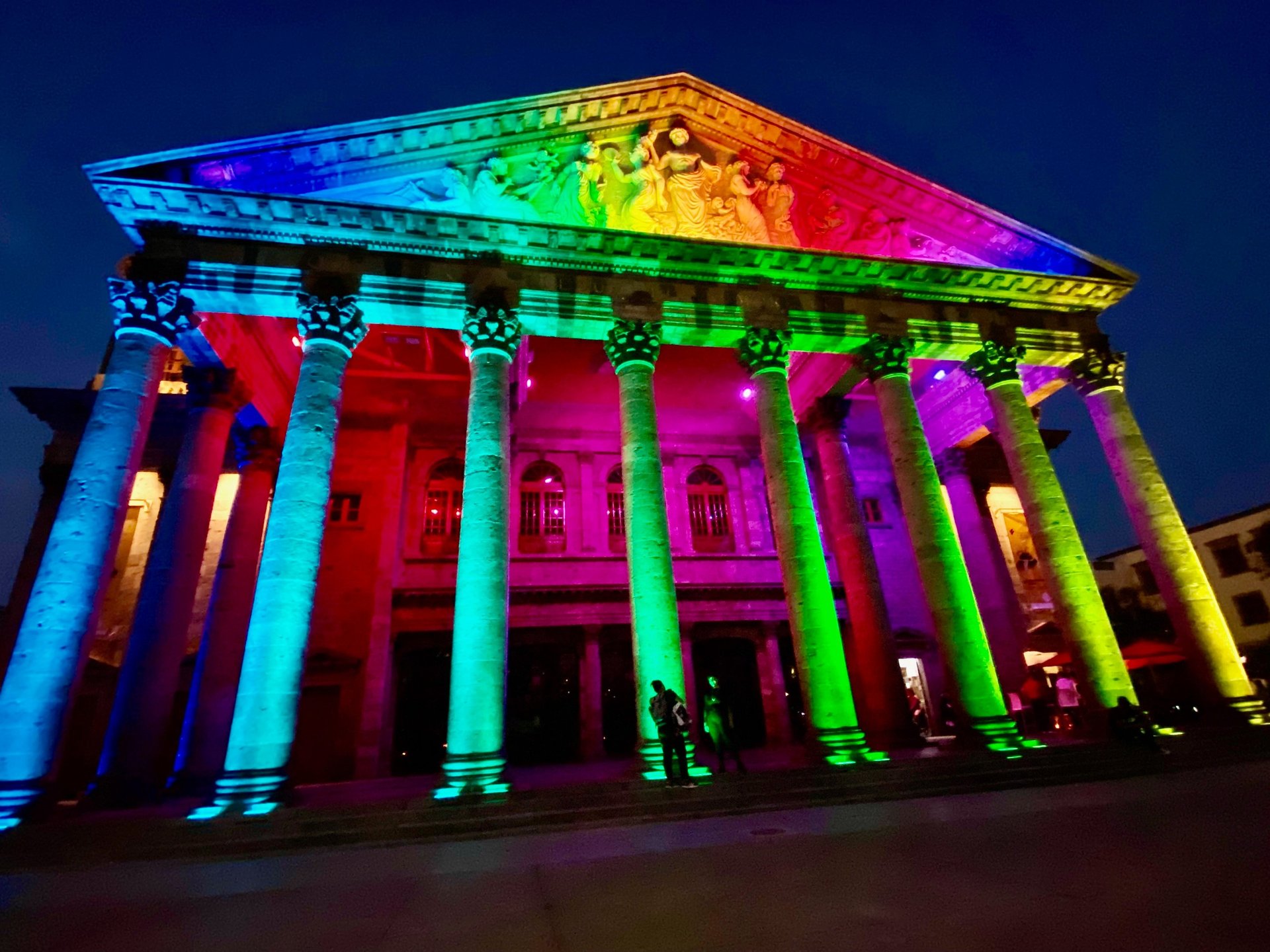
The City of the Future Already Exists, and It Looks Like Guadalajara in the Late 18th Century
Guadalajara’s Historic Centre is a model of a compact, sustainable and people-centred city. But we need to believe in its potential and unlock it through urban regeneration.


by: Ramiro Alberto Ríos - Director, reHabitar Urbanismo
When we imagine “the city of the future”, we tend to think of all kinds of technological advances: artificial intelligence solutions, great skyscrapers, megaprojects, major urban infrastructure works and, of course, electric and autonomous vehicles. The future of cities is often portrayed as spectacular, complex and technologically advanced. Yet I believe that a truly future-ready city is defined not by the latest technology or most sophisticated “gadgets”, but by what it offers the people who live in it in terms of improving the quality of urban life: proximity, sustainable, accessible and affordable mobility options, employment, a dynamic local economy, affordable and adequate housing, and streets, buildings and public spaces designed at human scale. It is a city where people can carry out much of their daily activities without relying on cars; where local businesses and residents have opportunities to thrive; where everyday needs are within walking distance and getting there is an enjoyable experience; and where architecture and public spaces encourage people to gather, interact and live the city.
From this perspective, the city of the future looks much more like Guadalajara as it began to take shape in the late 18th century, compared to the metropolitan area we have built over recent decades: a city that has sprawled towards its outskirts, with poorly defined urban boundaries and inadequate public services, including public transport and drinking water supply. Paradoxically, some of the solutions we are now seeking to build better cities were already in place long before cars, smartphones and artificial intelligence existed.
Despite nearly five centuries of history and decades of abandonment, deterioration, population loss and accumulated stigma, Guadalajara’s Historic Centre retains an urban form, cultural vitality and economic activity that give it enormous potential to become a model of sustainable urban living. Its street layout, heritage buildings, squares, traditional markets and local shops, together with the diversity of activities it still features, represent far more than an architectural and cultural legacy. They provide the foundations for reclaiming principles that are now central to contemporary urban planning: the compact city, mixed land uses, proximity to everyday services, human-scale mobility, neighbourhood economies and resilience. This is not about romanticising the past or overlooking the challenges facing the Historic Centre today. It is about recognising that many of the qualities we seek in more sustainable cities already exist here, and that we need to believe in their value and commit to unlocking their potential. The challenge is not necessarily to transform the Historic Centre into a city of the future, but to bring its neighbourhoods back to life through a structured urban regeneration strategy that protects, strengthens and adapts the qualities that have allowed them to function and retain their identity for centuries.
WE DESTROYED MOST OF OUR ARCHITECTURAL HERITAGE FROM THE 18TH CENTURY, BUT THE STREET GRID REMAINS.
The definitive founding of Guadalajara in 1542 featured a significant characteristic: it involved establishing a new city on a territory where its urban organization could be defined from scratch. Its layout followed principles of territorial and urban planning that would later be codified in the Laws of the Indies, a set of regulations enacted by the Spanish Crown to govern the founding and organization of cities across its American (and Asian) territories. Both civil and religious authorities, as well as friars from various religious orders, played a role in shaping the city’s configuration and influencing the organization of urban life. The arrangement of buildings and the urban fabric were designed to meet the religious, administrative, political, social, and economic needs of the era; consequently, the most important structures were concentrated around the Plaza Mayor (known today as Plaza de Armas). This area housed the Cathedral, government buildings, and the residences of the most influential families, as can be seen in the following map of the city from 1745.
PLANO DE GUDALAJARA EN LA NUEBA GALICIA, ELABORADO POR FRAY JOAN FRANCISCO ESPINO, 1745
Source: General Archive of the Indies, Seville, Spain
The result was a city organized by a grid of relatively regular streets and blocks, with a clear hierarchy of public and private spaces where plazas, churches, administrative buildings, and residences were integrated into a compact structure with short distances between key destinations. It was a city designed to be navigated by foot. Although this urban organization reflected the political, religious, and social structures of its time, it ultimately proved to be an urban framework worthy of the future city we so often envision: interconnected streets, moderately sized blocks, strategically distributed public spaces, and a diversity of activities that allowed (and still does) much of daily life to happen within a short distance.
In fact, the streets of the city as it stood by the end of the 18th century enhance the walkability of much of the area of both the A and B perimeters of the Historic Center. Remarkably, nearly five centuries after the city’s founding, many of these principles remain fundamental to the creation of sustainable cities. Concepts we now refer to as the "compact city," "urban proximity," or "human-scale mobility" are not necessarily modern inventions; they are qualities that Guadalajara integrated into its fabric long before modern urban planning existed as a formal discipline. In this sense, the Historic Center preserves something that has largely been lost as the Guadalajara Metropolitan Area (AMG) has expanded: an urban structure where housing, commerce, services, public space, and economic/cultural land uses are located in close proximity. In fact, this proximity is one of the most valuable characteristics of the cities we aspire to build today.
¿WHY IS GUADALAJARA'S HISTORIC CENTER A GOOD EXAMPLE OF THE CITY OF THE FUTURE?
When I think about what the cities of the future should look like, I find it interesting to discover that many of the principles we promote today as urban planners are already present in the Historic Center of Guadalajara, something I have experienced firsthand, and, above all, confirmed by walking its streets for over nearly 15 years now. Concepts such as the "15-minute city," transit-oriented development, active mobility, and mixed land use are all rooted in a simple idea: bringing the city closer to people and making their daily lives easier. I believe the historic center has much to teach us in this regard. Let’s look at four of these characteristics, which I consider fundamental for the city of the future.
1. Urban mobility at a human scale: a city worth walking
Source: Ramiro Alberto Ríos
One of the greatest strengths of local neighborhoods in the Historic Center is their human scale and compact structure, which allow for quick and direct travel on foot. The grid of interconnected streets and city blocks, measuring roughly 75 meters from corner to corner enables efficient access to a wide variety of destinations. For instance, walking from Jardín de la Reforma to the Templo de San Francisco takes less than ten minutes and covers ten city blocks, passing by banks, markets, shops, theaters, museums, churches, public squares, and historic buildings. Similarly, traveling from Paseo Alcalde to Calzada del Federalismo via streets like San Felipe, Juan Manuel, or Hidalgo also takes less than ten minutes, offering access to numerous businesses, restaurants, and services. This proximity makes it possible to handle many daily needs on foot, whether buying bread, visiting a market, picking up medication, heading to an office, or meeting someone in a public square, café, or bar.
Furthermore, public transport networks and the public bikeshare system connect the city center with other central neighborhoods such as Colonia Americana, Santa Tere, and La Moderna. Walking, cycling, and using transit thus form a single, sustainable mobility network. This is one of the key lessons from the historic center: large-scale infrastructure is not always necessary to facilitate movement. Often, it is enough to bring destinations closer together, connect streets, and provide public spaces that are safe, comfortable, and pleasant for walking. The city of the future should not be measured by the speed at which cars can traverse it or whether car parking is easily available, but rather by the ease with which its inhabitants can access the opportunities it offers. For me, this has meant that I do not need a car; I can organize my daily life by walking, using the bikeshare system, and taking advantage of public transport.
2. Architecture & public spaces at a Human scale: A city that invites you to admire it from its streets.
Source: Ramiro Alberto Ríos
Despite the sytematic destruction of the built heritage that has occurred over decades, and the recent construction of large-scale developments, the traditional architecture of the Historic Center largely retains a human scale that fosters a connection between buildings and people. Facades of moderate height, balconies, windows facing the street, entryways (Zaguánes) visible from the sidewalk, interior courtyards in public buildings, corridors, and porticos or covered archways all create a visual, physical, and everyday connection between this architecture, the public realm, and the people themselves. This makes strolling through the streets of the Historic Center a highly pleasant experience, allowing us to rediscover our city center and appreciate its historic architecture. For this reason, the center draws many local and international visitors, especially in the afternoons and on weekends—who come to take in and experience its architecture and public spaces.
This human scale is also evident in the relationship between landmark buildings such as the Cathedral, the Degollado Theater, and the Government Palace—and the network of streets, plazas, and pedestrian paths that give them their collective meaning. A human scale does not preclude vertical growth; rather, it requires that new architecture maintain an appropriate relationship with existing heritage, public space, and, above all, the people who use it. The quality of a city does not depend on the height or spectacular nature of its buildings, but on how those structures contribute to the creation of streets, plazas, and spaces where people want to live, stroll and interact with one adother.
3. Barrio economics and the traditional markets: the city that generates opportunities for all, near were you live
Source: Ramiro Alberto Ríos
The city of the future also requires a dynamic local economy, capable of generating employment, attracting businesses across various sectors, providing services, and maintaining a direct connection with the communities that live in them. Historically, the streets of the Historic Center have been home to a concentration of shops, workshops, eateries, bakeries, and markets that addressed many of the daily needs of those living nearby and throughout the wider metropolis. Although many businesses and traditional uses have been lost, this legacy persists: within an area of roughly 30 city blocks—bounded by Calzada Federalismo, Jesús García, Hidalgo, and Calle Belén—one can still find at least three traditional markets, alongside numerous street markets (known as "tianguis"), grocery stores, hardware stores, workshops, restaurants of all sizes, hotels, and other specialized businesses. A case in point is the stretch of Calle Juan Manuel; over the course of just 10 blocks, one encounters toy stores, markets, health food shops, stationery stores, and an endless array of food establishments.
Local markets and neighborhood shops are more than just sites for economic exchange; they are spaces for social interaction, sources of opportunity for small-scale merchants and producers, and gathering points that keep the streets vibrant throughout the day. Their presence also enhances the quality of life in the city center and encourages sustainable mobility, as residents can access food, goods, and services by foot, while economic activity is generated within the neighborhoods themselves. Furthermore, an economy distributed among numerous small businesses creates opportunities for a wider range of people and avoids an over-reliance on large retail chains, something we are currently loosing the battle to.
The Historic Center demonstrates that a robust urban economy need not be built around massive shopping malls; rather, it can emerge from the thousands of everyday activities that sustain the relationship between the city and its inhabitants. A prime example of this vibrant economy can be found around the Mercado Corona—a space where economic activity is not confined to the stalls within the market itself, but instead its economic activities spill out into the surrounding blocks in every direction. In the course of my daily errands, I can drop off my bike at the local repair shop, grab some delicious birria tacos for breakfast, leave a pair of shoes to be repaired, and stop by the market to pick up vegetables to prepare lunch—all along essentially the same street, covering less than 3 km in under an hour. To me, this is a true luxury; it makes my surroundings pleasant, all without the need to rely on a motorized vehicle.
4. Mixed land uses: an urban environment where all necesities of life happen in the same space
Source: Ramiro Alberto Ríos
Perhaps one of the most important, but likely one of the least recognized characteristics of the city center is its diversity of land use. Unlike many contemporary urban developments, where housing, offices, and commercial spaces are concentrated in separate zones, the Historic Center of Guadalajara retains a mix of activities that coexist within the same streets and city blocks: residences, shops, offices, schools, universities, places of worship, restaurants, markets, public institutions, cultural spaces and activities, and professional services. This diversity allows us to live, work, study, shop, handle administrative tasks, and enjoy cultural activities without having to travel long distances. From the perspective of sustainability, this proximity encourages walking and cycling, reduces reliance on automobiles and the demand for parking, and allows for more efficient use of existing infrastructure and better use of public spaces.
It also generates economic benefits, as businesses serve residents, workers, students, and visitors alike, while housing, cultural spaces, and services all benefit from their proximity to one another. More importantly, this mix of uses helps build vibrant neighborhoods, characterized by daily activity and opportunities for social interaction—though some areas still empty out once the workday ends. While this structure is preserved unevenly and there are still significant spaces in need of revitalization, strengthening it requires restoring housing, rehabilitating vacant buildings, facilitating the establishment of small businesses, and maintaining cultural and educational facilities. The city of the future should not be organized into large, single-use zones; rather, it should consist of diverse neighborhoods where it is possible to live, work, study, and enjoy life without having to constantly travel from one end of the city to the other.
URBAN REGENERATION AS A TOOL TO UNLOCK THE FULL POTENTIAL OF GUADALAJARA'S HISTORIC CENTER
Source: Ramiro Alberto Ríos
Guadalajara’s Historic Center is not merely a legacy of the past to be preserved only for its historical and architectural value; it is also an area with enormous potential to address the urban challenges of the 21st century. Its compact structure, walkable distances, diverse range of activities, traditional markets, human-scale architecture, and cultural richness embody many of the qualities we currently seek in sustainable cities. This does not mean idealizing the area or ignoring its current and future challenges—such as urban decay, safety, abandonment, abandoned housing, traffic congestion, and a lack of more adequate public space. In my view, the key to unlocking its full potential begins with protecting and restoring what we already have and that has been sucessful over the last nearly 500 years.
According to the 2017 Partial Urban Development Plans (PPDU) for the Historic Center—which has not been updated for nearly a decade— today, nearly 25% of the properties in the center are abandoned. This abandonment has been taking root for decades: it includes properties tied up in unresolved inheritance (intestate estates), old houses inherited by owners who do not know what to do with them or simply do not want them, and buildings that have been partially or entirely abandoned due to a lack of resources for repairs.
However, abandonment is not the only challenge; underutilization is even worse. Underutilization refers to a number of buildings—both residential and commercial, that are not being used efficiently. For instance, there are large, traditional Casonas with businesses on the ground floor, while the second and even third floors are used merely as storage space. Significant commercial zones within the Historic Center exhibit these characteristics, with properties that are partially abandoned or left entirely unused. As a result, these areas become deserted at night; with no "eyes on the street," this creates the sense of the area being usafe. There is no data available regarding the underutilization of properties in the city center—information that would be invaluable for assessing this complex challenge and devising solutions.
To harness this potential, Guadalajara must drive a comprehensive urban regeneration process that reduces abandonment and breathes new life into its buildings, streets, and neighborhoods. Revitalizing the center without displacing the people who keep it alive, requires a range of essential actions: reclaiming housing, rehabilitating heritage properties, promoting affordable housing, strengthening local markets and small businesses, improving public transit, and creating more and better public spaces that are both accessible and inviting.
It is, in my view, highly urgent to develop a comprehensive urban regeneration master plan to rescue the city center. The partial plans (planes parciales) implemented to date are general in nature; while they contain valuable information, they fall short when it comes to concrete urban planning and regeneration initiatives. In this regard, a dedicated recovery and regeneration plan for the city center should, in my opinion, incorporate specific strategies with actionable steps spanning the short, medium, and long term, across at least the following areas:
1. Restoration and Conservation Plan for Heritage Properties
Currently, there are initiatives that reward the restoration and conservation of heritage properties. While these are positive, they tend to favor owners with the greatest financial capacity to invest (upwards of 5 million pesos), often in high-demand areas like the Colonia Americana. The municipality could go further by implementing a comprehensive plan that combines economic incentives and disincentives to drive the recovery of the built heritage. For instance, it could impose taxes on owners of vacant lots and abandoned properties, while offering discounts or subsidies on utility payments for properties that incorporate multiple restored housing units or economic spaces within a single property. Such measures could encourage higher population density and strengthen local neighborhood economies.
2. Strengthening Governance in the Historic Center The Historic Center urgently requires a robust institution—one equipped with decision-making authority and staffed by professionals prepared to tackle the challenges of urban regeneration. Although a "Superintendency of the Historic Center" already exists, it needs to be strengthened—both technically and financially—to effectively address future challenges. Furthermore, it is essential to ensure the institution’s continuity and autonomy, regardless of changes in municipal or state government; historically, its functions and priorities have shifted depending on the administration currently in power.
3. Pedestrian Street Network Plan and Public Space Management
This plan should serve as the backbone for the urban regeneration of the Historic Center. We need to establish clear goals for pedestrianizing streets, restricting access for motorized vehicles, and designating specific areas for loading and unloading. The objective is to create a pedestrian network that highlights the value of the area’s heritage architecture, the quality of its public spaces, and the overall experience of life in the city center, and banning the negative externalities that come with high motorized vehicle volumes.
The Centro Histórico also faces significant challenges regarding parking management, a lack of oversight, and the appropriation of public space for private vehicle use, a situation exacerbated by lax and ambiguous regulations. Although some areas have regulated parking, many residential streets lack any form of control or fees. This allows people who work in the city center - especially those employed in government offices, to use the surrounding residential streets as free parking, which encourages the use of private cars over public transit. I see this on my own block: fewer than half of the residents own a car, yet during the work week, it is practically impossible to find an open parking space at any time of day. Conflicts between neighbors over parking are frequent, and even ilegal "parking managers" pop up on the streets.
4. Comprehensive affordable, accessible and adequate Housing Plan. According to data from the Urban Development and Partial Plans (PPDUs) for the Historic Center, a housing deficit of 32,994 units is projected by 2045. To meet this demand, it would have been necessary to build 1,435 housing units annually starting in 2022, this translates into constructing roughly four housing units per day from 2022 until 2045. We are far from reaching that pace, especially considering that the housing currently being built in Guadalajara is not affordable for a large portion of the population. Revitalizing the residential use of the city center must, therefore, be an urgent priority.
5. Citizen Participation, Communication, and Awareness Plans for the Historic Center. Ever since the definitive founding of Guadalajara, there have been records indicating that certain parts of the city center, particularly neighborhoods inhabited by Indigenous populations, such as Analco—were viewed as undesirable by specific economic and social groups. This stigmatization has a long history. In 1630, for instance, Guadalajara’s city councilors sent a letter to the Spanish Crown requesting the incorporation of Analco into the city, citing issues of “mismanagement and crime.” It is striking that these same labels remain associated with the neighborhood nearly four centuries later. This stigma still weighs on the Historic Center, and we need to tell a different story: one of a place full of opportunity, where anyone can contribute to restoring its traditional neighborhoods, strengthening its communities, and building a more vibrant and attractive city center.




All Rights Reserved
reHabitar Urbanismo 2026
info@rehabitar.com.mx